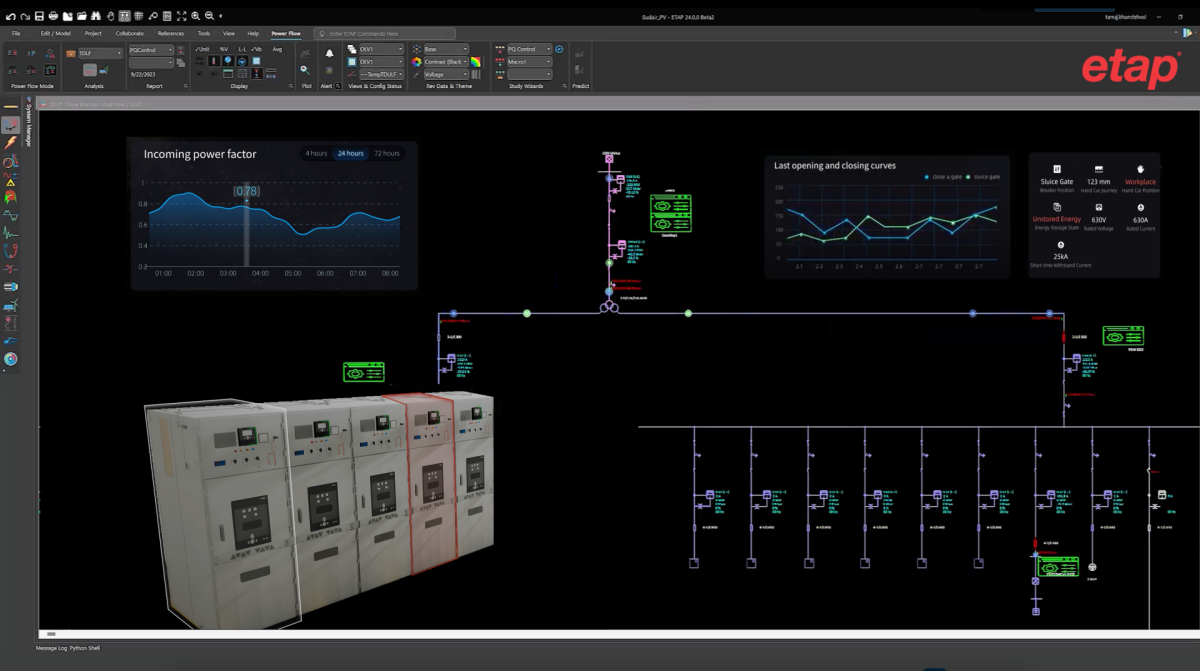
Schneider Electric and ETAP, the industry and technology leader in power system design and operation, are unveiling a cutting-edge digital twin that can accurately design and simulate the power needs of AI Factories. Leveraging the NVIDIA Omniverse™ Blueprint for AI factory digital twins, Schneider Electric and ETAP enable the development of digital twins that bring together multiple inputs for mechanical, thermal, networking, and electrical systems to simulate how an AI Factory operates. The collaboration is set to transform AI Factory design and operations by providing enhanced insight and control over the electrical systems and power requirements, presenting an opportunity for significant efficiency, reliability and sustainability gains.
While basic visualization of electrical systems was previously possible, the integration of ETAP and NVIDIA Omniverse technologies enables the creation of a comprehensive AI Factory digital twin where multiple dynamics interact seamlessly. ETAP’s sophisticated modeling technology will create a virtual replica of a data center’s electrical infrastructure and combine it with real-time power system data, advanced analytics, and insights. Intelligent algorithms analyze and predict power consumption and distribution patterns, allowing unprecedented insights into:
● Advanced electrical system design and simulation
● Dynamic “What-If” scenario analysis
● Real-time electrical infrastructure performance tracking
● Advanced energy efficiency optimization
● Predictive maintenance and system reliability assessment
● Infrastructure needs based on power usage that can help reduce total cost of ownership
From large-scale training clusters to edge inference servers, AI workloads are driving a significant increase in data center power consumption. Unlike traditional computing tasks, AI operations — particularly model training and complex inference processes — require substantial computational power, leading to higher rack power densities. As AI adoption accelerates, startups, enterprises, colocation providers, and internet giants must rethink data center design and management to address the growing need for power efficiency.
ETAP and NVIDIA’s collaboration introduces an innovative “Grid to Chip” approach that addresses the critical challenges of power management, performance optimization, and energy efficiency in the era of AI. Currently, data center operators can estimate average power consumption at the rack level, but ETAP’s new digital twin aims to increase precision on modeling dynamic load behavior at the chip level to improve power system design and optimize energy efficiency.
This collaborative effort highlights the commitment of both ETAP and NVIDIA to drive innovation in the data center sector, empowering businesses to optimize their operations and effectively manage the challenges associated with AI workloads. The collaboration aims to enhance data center efficiency while also improving grid reliability and performance.
“As AI workloads grow in complexity and scale, precise power management is critical to ensuring efficiency, reliability, and sustainability,” said Dion Harris, Senior Director of HPC and AI Factory Solutions at NVIDIA. “Through our collaboration with ETAP and Schneider Electric, we’re offering data center operators unprecedented visibility and control over power dynamics, empowering them to optimize their infrastructure and accelerate AI adoption while enhancing operational resilience.”
“This collaboration represents more than just a technological solution,” said Tanuj Khandelwal, CEO of ETAP. “We’re fundamentally reimagining how data centers can be designed, managed, and optimized in the AI era. By bridging electrical engineering with advanced virtualization and AI technologies, we’re creating a new paradigm for infrastructure management.”
Pankaj Sharma, Executive Vice President for Data Centers, Networks & Services at Schneider Electric added, “Collaboration, speed, and innovation are the driving forces behind the digital infrastructure transformation that’s required to accommodate AI workloads. Together, ETAP, Schneider Electric, and NVIDIA are not just advancing data center technology — we’re empowering businesses to optimize operations and seamlessly navigate the power requirements of AI.”