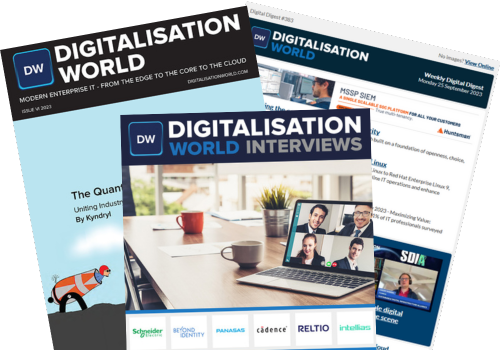
Digital Newsletter
Each week our editor Phil Alsop rounds up the most popular articles, videos and expert opinions. We compile this into a Digital Newsletter and send it straight to your inbox every week.
Digital Magazines
We'll let you know each time a new edition of Digitalisation World is released so that you're always kept up-to-date with the latest and greatest news and press releases.
Video Magazines
The Digitalisation World Video magazine contains the latest Zoom interviews with experts in the industry.
The winds of change are redirecting mainframe modernization strategies worldwide, according to Advanced’s Fourth Annual Mainframe Modernization Business Barometer Report. Faced with mounting competition and economic uncertainty, 92% of global enterprises are changing course to retain mainframes as part of pragmatic hybrid strategies, rather than pursuing wholesale cloud shifts.
The report, which surveyed 400 IT leaders worldwide, reveals hybrid infrastructure strategies taking hold to balance workloads across cloud and mainframe. In fact, just 6% expect outright mainframe replacement anytime soon. Instead, most are pursuing selective workload migration especially coupled with AI integration.
“The pressure to migrate all data to the cloud has faded,” said Tim Jones, Managing Director of Application Modernization at Advanced. “With half of respondents’ critical information still on mainframes, but only 8% of their IT budget allocated there, retaining mainframes as part of hybrid strategies makes the most sense for innovation, efficiency, resilience and sustainability.”
Initially hailed as a silver bullet, wholesale migration faced setbacks due to unforeseen complexities around legacy system interdependencies. Amidst budget constraints and economic headwinds, the renewed focus on mainframes' stability prompts a strategic shift. Meanwhile, intensifying competition continues driving selective workload migration to boost agility in addition to the following key factors:
Turbocharging with AI: The promises of AI on huge productivity and problem-solving gains has enticed more than 81% of organizations to act on its potential. Specifically, 52% are accelerating migration to access AI/ML capabilities more readily and 29% are pursuing integration directly on mainframes.
Breaking mainframe silos through DevOps: Modernization drives a 96% increase in DevOps adoption, fostering collaboration over cumbersome processes. However, challenges persist around the integration of tools, processes, and culture, especially in government (76%) and manufacturing (62%).
Efficiency and sustainability improvements: Modernization positively impacts sustainability goals for 89% of respondents, marking a 17-point increase since 2021. IT priorities include contributing to green initiatives (42%), enhancing reputation (38%), and improving energy efficiency (37%) through consolidation, scalable cloud solutions, clean energy mix, and mainframe optimization.
External expertise boosts outcomes: Despite 46% planning modernization solely internally, only 22% of past projects succeeded this way. Partners provide specialized skills and proven methodologies to smooth initiatives.
“Rather than all-or-nothing migrations, nuanced workload-by-workload evaluation and staggered transitions aligned to business priorities better balance legacy reliability with next-gen innovation," Jones concluded.