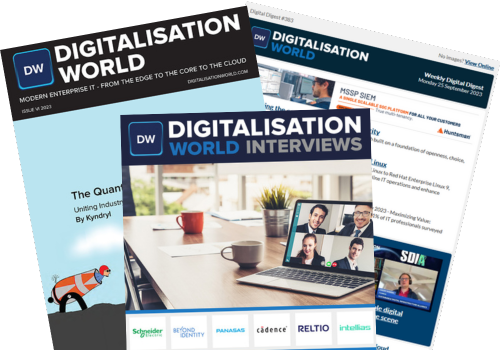
Digital Newsletter
Each week our editor Phil Alsop rounds up the most popular articles, videos and expert opinions. We compile this into a Digital Newsletter and send it straight to your inbox every week.
Digital Magazines
We'll let you know each time a new edition of Digitalisation World is released so that you're always kept up-to-date with the latest and greatest news and press releases.
Video Magazines
The Digitalisation World Video magazine contains the latest Zoom interviews with experts in the industry.
Elastic has published a new study that shows employee experience has become a new priority for IT leaders as they reinvent their infrastructures to support remote workforces. The commissioned study titled The Changing Role of the IT Leader was conducted by Forrester Consulting on behalf of Elastic in February 2021, one year into the global pandemic, and published in April. The study can be downloaded here.
Based on a survey of 1,000 CIOs and IT leaders in 10 countries1, the study illustrates that an adaptive business model with employee experience at its core is the key to building business resilience, creating a sustainable competitive advantage, and scaling effectively in times of disruption.
Since the start of the COVID-19 pandemic, the shift to remote and hybrid working models has become a permanent fixture for many global organizations. Nearly 60% of IT leaders believe that enabling employees to work flexibly will improve the adaptiveness of their organizations and they are investing in technology to improve employee experience and productivity.
Globally, the partnership between IT and HR is growing stronger, with 57% of IT leaders collaborating more closely with their HR counterparts since the start of the pandemic.
While many IT leaders worldwide have pivoted to an employee-centric approach in their technology decisions, they still face barriers to establish an environment where IT fosters engagement and productivity.
IT leaders report that 92% of organizations worldwide are in survival or maintenance mode.
60% of IT organizations are investing in improving employee experience to support remote workforce productivity and performance, but don’t have access to the budget and tools to do so.