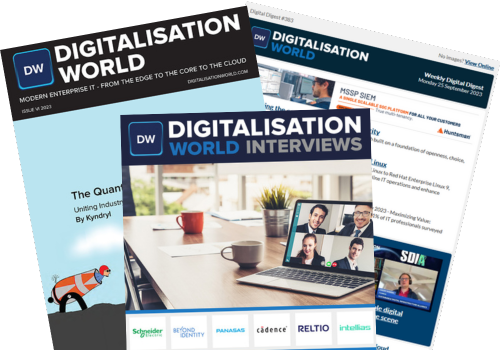
Digital Newsletter
Each week our editor Phil Alsop rounds up the most popular articles, videos and expert opinions. We compile this into a Digital Newsletter and send it straight to your inbox every week.
Digital Magazines
We'll let you know each time a new edition of Digitalisation World is released so that you're always kept up-to-date with the latest and greatest news and press releases.
Video Magazines
The Digitalisation World Video magazine contains the latest Zoom interviews with experts in the industry.
Sophie Milburn: A lot of the discussion around AI and management focuses on reducing headcount. What do you think that narrative misses?
Jonathan Hassell: The narrative isn't wrong that there's slack to cut. Plenty of organisations are genuinely over-layered, and a real share of management work is coordination overhead - aggregating status, routing decisions, scheduling, first-pass synthesis of what's happening below. AI absorbs that well.
What the headcount framing misses is the residual, the part that doesn't compress. In real organisations, management is one of the places concentrated judgement accumulates: prioritising when everything is urgent, making the call when the data is thin, coaching people through ambiguity, developing talent over multi-year arcs. Strip the layers without distinguishing the overhead from the judgement and you save money this quarter while quietly draining mentorship, decision quality, and the ability to course-correct. It looks like efficiency but you just pay the cost later, not immediately. It is not a free lunch.
For my money the useful question isn't "how many managers can we remove," it's "what does the job become when the coordination load is gone." My bet is the duties get narrower and heavier - fewer people, each spending far less time on synthesis and far more on the judgement-dense work that doesn't delegate to a model, such as the calls, the coaching, and which bets to make. You’ll have different spans of control, different things you promote people for, with AI owning the reporting layer, and most organisations don't have this yet. They have the cost-cutting instinct without the redesign, which is how you get the layoff without the rethink.
Sophie Milburn: If AI takes over more administrative and coordination tasks, what becomes the defining value of a great manager?
Jonathan Hassell: Accountability.
It's tempting to say the defining value is something AI is currently bad at, but it's a shaky place to plant your flag, because that frontier keeps moving; reading context and generating decent coaching language are exactly the things models got good at fast. Pin a manager's worth to a capability gap and you're betting on the gap staying open, and I think we all see the bleeding edge moving closer and closer.
But someone still has to be answerable for a call or a bet. AI can generate feedback signals all day, but it can't be held responsible for them. A great manager is the person who takes that noisy signal, decides what it actually means, and owns the decision that follows. Part of that job is keeping the signal honest: making sure a dashboard doesn't quietly become the truth, that a feedback number doesn't flatten into a one-dimensional score someone's career rides on. The harder part is making a call people can understand and trust when there's no clean metric to point at, and standing behind it when it's wrong.
Good management is judgement someone is willing to be accountable for. If the job degrades into "confirm what the dashboard says," you've already lost it.
Sophie Milburn: You’ve said management becomes a “higher-leverage skill” in an AI-enabled workplace. What does that look like in practice day-to-day?
Jonathan Hassell: The honest answer is that most of it shows up as where the time goes, not as some new heroic activity.
At the start of the day, an agent has already summarised what moved overnight - threads, tickets, where things are stuck. The old version of that was me spending the first hour reconstructing status from six places. Now I read a digest and the question changes from "what happened" to "is this read of the situation right, and what's it missing." That's the shift: I spend almost no time gathering and most of it judging.
One-to-ones change the most. They stop being "tell me what you did" because the system already knows what you did. The discussions become "here's what the data thinks is going on with your work; is that true, and what do we do about it?" Sometimes the most useful thing I do all week is tell someone the dashboard is wrong about them, because the signal missed the context. That conversation didn't exist before, but now it's central.
Then there's the work that looks like nothing on a calendar. An agent drafts the performance summary, but I'm the one who decides whether it's fair, and who owns it when I deliver it. AI can structure a development plan, but it can't sponsor someone in the room they're not in, or notice that a quiet person is about to leave. The day gets lighter on coordination and heavier on calls, with more decisions per hour, fewer of them with a clean metric attached.
More decisions per hour means more momentum which means a higher op tempo which is something that ought to satisfy all the stakeholders.
AI gave me back the hours I used to spend finding out what was happening, and the whole job is now what I do with those hours. Done badly, that time evaporates into more meetings. Done well, it goes into the two things that compound: better decisions and better people.
Sophie Milburn: Where do you think organisations are most at risk when introducing AI into performance management and people operations?
Jonathan Hassell: I come back to accountability. You cannot automate the measurement of performance without automating the accountability for it. You end up with a system that confidently rates people, and no human who actually owns those ratings.
The mechanism is simple and it's already common. Performance is contextual and multidimensional, but a model can only act on what it can see, and what it can see is what's easy to capture, objective things like tickets closed, messages sent, hours online, and the like. The system quietly starts rewarding the legible work and discounting the invisible work, like the person who unblocks everyone else, mentors the new hire, or calms the angry client. None of that shows up in the data, so the system reads them as low performers. You might not even notice until your best people are the ones leaving.
The deeper trap is that the standard fix makes it worse. Everyone says "human-in-the-loop," but in practice the human becomes a rubber stamp: they approve what the system surfaces because overriding it is work, it's friction, and the system looks authoritative. Most of us have been at an airline counter, asked for some help, and been told, “the computer says no.” Imagine that in your workplace, but even worse, with the appearance of human judgement laid over an automated decision nobody really examined. It’s worse than open automation, because now there's a name on a decision no one actually made.
The best organisations are becoming the ones where an employee can see what fed a judgement, challenge it, and reach a human who genuinely owns the outcome rather than ratifying the machine's.
Sophie Milburn: How should companies decide what parts of management should remain human-led versus AI-assisted?
Jonathan Hassell: I'd push back gently on the usual framing, which sorts tasks into human or AI buckets. That's the wrong unit. Almost every management task is already a mix. You draft with AI, decide as a human. "Is this task human or AI" has no clean answer. The better question is, for a given decision, what is AI allowed to do to it? Surface it, shape it, recommend it, or make it?
Once you frame it that way, the line draws itself along two axes. First, how cheap is it to undo if the system is wrong. Second, if we reverse something, who is owed an explanation, or are they at all?
Low cost to reverse and nothing owed - scheduling, summarising, routing, first drafts - let AI run.
High cost, or someone's owed a reason - pay, promotion, performance ratings, who gets put on a struggling project - a human decides, every time, and the AI's role is capped at "recommend."
The test I'd actually write into policy is the explanation test: if you can't explain a decision to the person it lands on, in terms they can challenge, you're not allowed to delegate it to a model. Not because the model is necessarily wrong, but because an unexplainable decision has no accountable owner, and a decision about someone's livelihood with no owner is the thing you're trying to avoid.
The piece companies skip is the escalation path. It's not enough to say "humans lead here, AI assists there.” You have to define what happens when the human disagrees with the system, and make overriding it genuinely low-friction. If the system is hard to override, the boundary you drew on paper doesn't exist, as in practice everything quietly drifts into "AI decides" because that's the path of least resistance.
Sophie Milburn: Do you think current managers are adequately prepared for this shift, or does AI require an entirely new management skillset?
Jonathan Hassell: No, not a new skillset. Most managers were promoted for execution. They were shipping, hitting the number, running the process - and the thing that gets scarce when AI absorbs the admin layer is exactly what they weren't selected for: judgement, and the nerve to apply it against a system that looks authoritative.
That second half is a genuinely new skill, and it's less technical than it sounds. The literacy that matters is interrogating them: what data is this based on, what's missing, what might be skewed, and what would make me change my mind? You don't have to be an ML engineer to ask those. You need the habit of asking them when the output is fluent and confident and easy to just accept, and most people don't have that habit, because nothing in their career rewards distrusting a clean-looking answer.
So: not a new skillset bolted on, but an old one, accountable judgement, suddenly load-bearing in people who often weren't chosen for it. Companies that assume managers will "figure it out" get brittle, metric-driven behaviour, because that's the safe default when no one has signalled it's safe to disagree with the dashboard. The ones that invest in the practice build better managers, not just faster workflows.
Sophie Milburn: One of the concerns people raise is that AI could erode mentorship and human connection at work. Do you see that risk, and if so, how can businesses avoid it?
Jonathan Hassell: Yes, but it's worth being precise about how, because the risk isn't really AI talking to people instead of managers. It's subtler than that. AI doesn't erode mentorship directly. I see it more as removing the excuse to keep it. The moment an agent can triage a manager's reports, summarise the work, and draft the feedback, you can defend giving that manager 30 direct reports instead of six. And at 30, mentorship is arithmetically impossible no matter how good the intent. The connection gets crowded out by a span of control that AI made look affordable. That's the trap, and it's the same one underneath everything else here. Mentorship is invisible work. It never showed up cleanly in the data, so when you're optimising against what you can measure, it's the first thing to quietly disappear, not by decision, but by neglect. Nobody chooses to cut it. It just stops fitting in the day.
Business and managers have to avoid spending their free time the lazy way. The freed hour can become a 31st report, or it can become the development conversation there was never time for before. If growing people doesn't affect a manager's own trajectory, no amount of protected calendar time survives the first busy quarter. As always, incentives matter, and what you measure, you get.
Sophie Milburn: Looking ahead three to five years, what will distinguish organisations that successfully integrate AI into management from those that struggle?
Jonathan Hassell: The organisations that struggle will have used AI to answer "how do we run management cheaper." They'll cut layers, push AI into performance processes, widen spans of control, and on every quarterly metric it'll look like it's working, right up until the trust runs out. What you've drained - judgement, mentorship, the willingness to make an accountable call - took years to build and doesn't come back with a memo.
The ones that succeed will have asked a different question: "what does management become when the admin layer is gone." Same tools, opposite intent. They'll have built the thing most organisations skip, an actual operating model. They’ll have decided what AI is allowed to decide versus only recommend, who's accountable when it's wrong, how someone challenges a decision that lands on them, and whether overriding the system is genuinely easy or just theoretically allowed. And they'll treat the freed-up hours as room for the human work - judgement, development, the relationships that compound - rather than as headcount to recover.
The dividing line is trust, and trust is downstream of accountability. The organisations that kept a human visibly answerable for the decisions that shape people's lives will earn it. The ones that hid behind the system will spend three years looking efficient and the fourth wondering where everyone went.