The proliferation of artificial intelligence (AI) has put datacenters in a unique state of risk. Datacenters are no stranger to security troubles (typically of the cyber nature) and so awareness of emerging threats across the sector is high. With more than 5,400 datacenters in the U.S.—the highest volume in the world and more being developed each day—these facilities have been critical not only in the global race towards technology dominance, but also in the day-to-day life of everyday people growing increasingly dependent on AI.
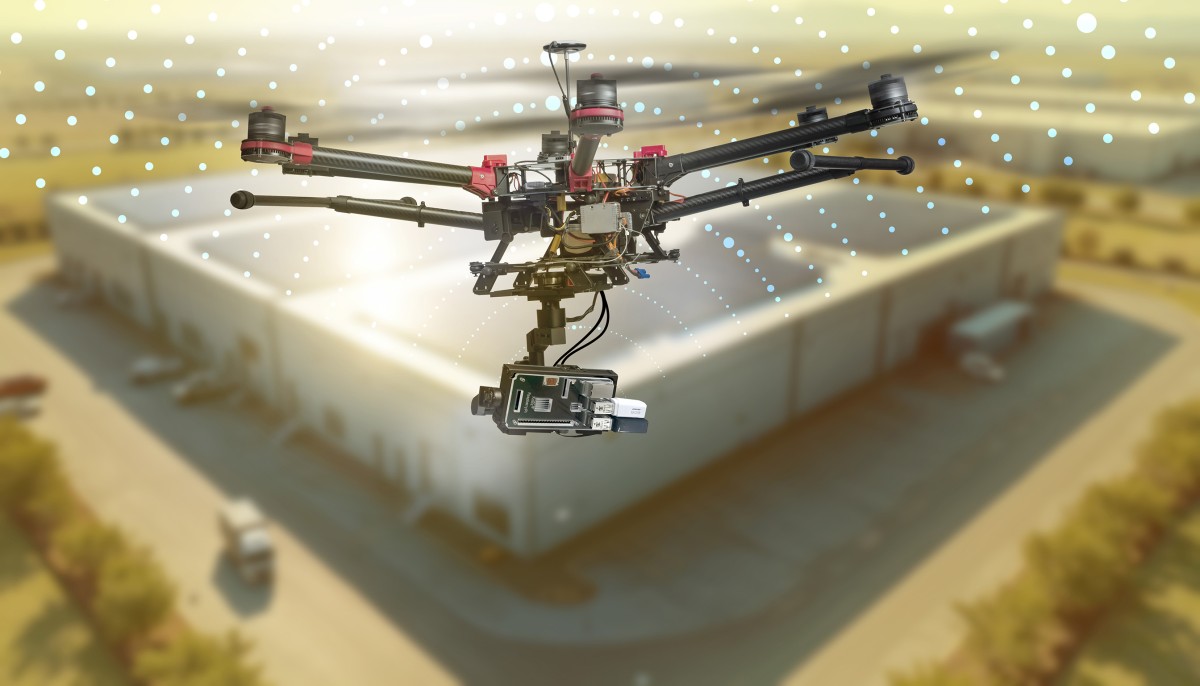
While the threat landscape is robust, one consideration has datacenter security professionals "looking up." In tandem with the increase of datacenter dependence is the proliferation of drones. As drone activity escalates in the airspace, from malicious activity to careless operators to legitimate commercial use, sites once considered safe are now having to reevaluate their security stacks to account for the air domain. To protect these vital facilities, datacenter security must evolve and embrace drone detection technology so they can respond to airborne threats before those threats damage infrastructure, injure personnel, facilitate data theft or breach, or cause other costly disruptions.
The drone danger: Why are these small aircraft such a big problem?
The explosion of the consumer and hobbyist drone market has done wonders to normalize the presence of aircraft in low-altitude airspace. Yet today's drones have evolved significantly. No longer just toys, modern commercial drones are capable of much more than a fun day of aerial exploration. Instead, they are able to capture high-resolution images, carry ever-increasing payloads, and perform long-range operations that make it difficult to track down an operator who might be up to no good. The challenge? The underestimation of these small aircraft has created the perfect opportunity for bad and careless airspace actors.
What makes the drone threat dangerous is the discreet way they operate, allowing them to fly into airspace undetected. Cyber criminals can land them unnoticed on rooftops to probe wireless networks for corporate espionage or to steal sensitive consumer data. A few years ago, at a U.S. East Coast financial firm focused on private investment, a DJI drone landed on the roof with a Wi-Fi pineapple device it had already used to intercept an employee’s credentials at his home in order to access the network at the business site. This incursion forced the firm to immediately assess the level of sensitive financial data that was compromised across their customer base.
In other cases, drones are used even more maliciously to disrupt operations by damaging equipment, hijacking cooling systems, or causing complete outages. Careless or curious operators are also muddying the airspace by flying drones into datacenters simply to “have a look around.” Even with these more innocent incursions, the stakes are much higher than casual curiosity because they produce unpredictable security responses and unnecessary risks to the data center's infrastructure.
The sensitive data hosted in datacenters supports a treasure trove of support critical platforms, including government information, healthcare systems, utilities operations, and AI workloads that maintain entire economies. We think of this information as being stored "in the cloud", but it's physically stored within the datacenters themselves. It doesn’t take much for the mind to wander into numerous ways this information can be exploited for everything from hacking personal data to performing system-wide shutdowns.
Recent illegal drone activity abroad and at home has sounded the alarm on these fears, including the German government pledging to combat illegal drone incursions more aggressively following the shutdown of one of its major airports last year. The shutdown left the airport inoperable overnight, leading the security team into a scramble and causing costly flight delays and cancellations.
Even more nefarious, a man attempted to fly a drone with a payload into a Nashville utility back in 2024, highlighting an alarming capability drones have to be used as weapons of mass disruption. Although the man was thwarted in his attempt and later detained, the story could have been much different if he had been able to carry out his plan. Events like these highlight the very real risk to the damage of infrastructure, but also the potential harm that can be caused to on-site personnel.
Making matters worse, online influencers have proven time and time again that the majority of datacenters simply aren’t prepared to combat illegal drone incursions. While some public videos of drone activity near datacenters might be intentionally light-hearted, they illustrate a very real vulnerability.
Conventional ground-based systems don’t see drones coming
To date, most traditional security systems don’t look beyond the fence line, with even fewer looking to the skies. While some security teams have added aerial monitoring through radio frequency (RF) sensors and cameras, this approach is inadequate with the emergence of modified "dark drones" that emit little to no RF signal. This visibility degrades even further when poor lighting or weather conditions affect camera performance.
This is why the security industry is adopting the multi-sensor fusion approach—several sensors operating in unison to fill gaps in awareness across the array. At the core of this approach is radar, able to deliver all-weather, all-lighting detection, tracking, and classification of drone movement, including registered and catalogued drones, non-signal-emitting drones, first-person-view drones (FPVs), and swarms (coordinated drone groupings)..
Modern radar systems designed for accurate drone detection and tracking provide round-the-clock awareness of every object moving on both the ground and in the air, and integrate seamlessly with existing command-and-control (C2) and video management systems (VMS). As the security industry continues to set the standard for the multi-sensor fusion approach, the holy grail of drone detection is widely seen as a foundational combination of high-fidelity radar, which cues cameras to lock on the drone, and pan-tilt-zoom (PTZ) cameras, which serve as the "eyes on the object." No single sensor works in isolation, and to minimize risk, each site requires a bespoke sensor stack that might also include acoustic or RF sensor types.
Now that you can see the drone, what can you do about it? Good news: Authorities are expanding
Complicating drone security further is the historic lack of legal authority to actively mitigate or disable drones once they've been detected. According to Federal Aviation Administration (FAA) law, drones are considered an aircraft - no different than commercial planes - and can't be tampered with in flight, even if they pose a serious risk. The authority to mitigate drones has been traditionally limited to certain federal agencies. However, positive changes are coming on this front, with recent updates to the Safer Skies Act signaling meaningful progress in extending mitigation authorities to state, local, and tribal law enforcement who receive proper training.
Despite the potential expansion of authority to state and local law enforcement, mitigation remains constrained for datacenter security operators who may wonder: why should I care if my authority is limited? The answer to this is three-fold: 1) early awareness gives you time to act and there is power in "soft mitigation" tactics; 2) collection of high-fidelity sensor data for immediate response, forensic analysis, and prosecution; and 3) future-proofing for immediate readiness when authorities expand.
Ultimately, while legal mitigation authority may still be on the horizon, the responsibility to prepare is not. Datacenter operators cannot afford to take a passive stance on drone-aware physical security. Early detection, actionable intelligence, and documented evidence create meaningful defensive advantages today while positioning organizations to respond immediately as authorities expand. In an environment where airspace threats are increasing and regulations are shifting, proactive awareness is no longer optional; it is a foundational component of modern infrastructure security.
As the AI race heats up, datacenters must secure the airspace
The drone threat to datacenters is very real, and as the AI race heats up, new centers will be built--and new defenses are required. A multi-sensor drone detection approach, with radar at its core, is the solution to preventing disruptions to operations and empowering datacenters to take action and secure the airspace. As these sites continue to solidify their place amongst traditional critical infrastructure sites, datacenter security teams can assume that bad actors will take advantage of the vulnerable air domain.